Author: indietimescoverage

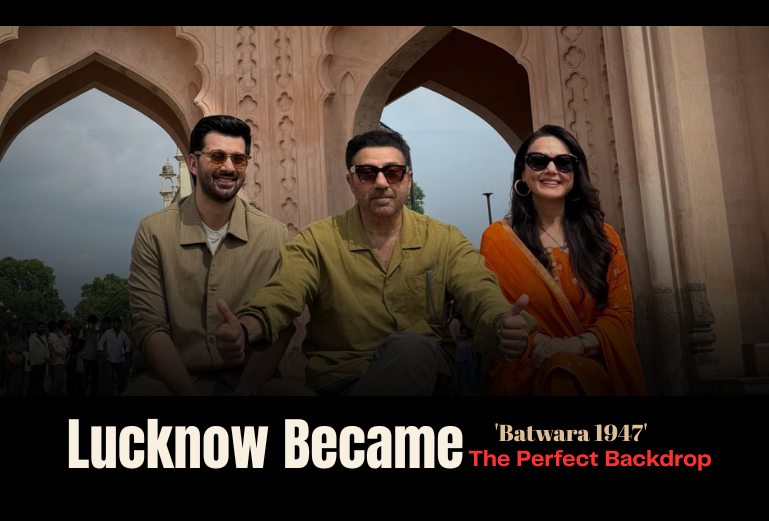
Lucknow Became the Perfect Backdrop for ‘Batwara 1947’

Lucknow witnessed a special blend of cinema, history and emotion as Sunny Deol, Preity Zinta and Karan Deol arrived to promote Batwara 1947. Their photo shoot at the historic Purana Lucknow Imambara gave the visit an evocative touch, bringing the stars face-to-face with a city whose architecture and soul carry centuries of stories dating back to India’s partition in 1947. The timing the for the visit to Lucknow was ideal with Batwara 1947 releasing on August 14, just a day before Independence Day, for the starcast of the film Lucknow  was like a especially meaningful stop. The film’s story of Partition, displacement, family and human resilience made the timing deeply poignant, a reminder that behind history’s biggest events are ordinary people, their homes, their memories and their hopes for a better tomorrow. During their visit the trio also met Uttar Pradesh Chief Minister Yogi Adityanath, adding another significant moment to their Lucknow visit.
Read more

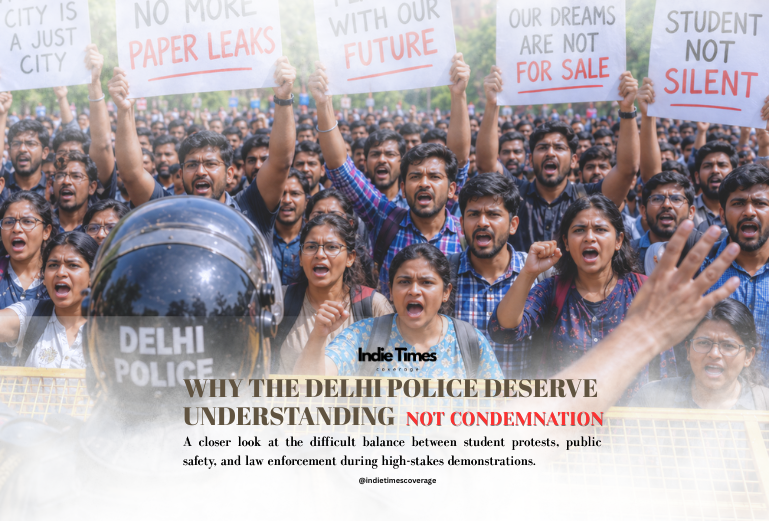
Between Order and Anarchy: Why the Delhi Police Deserve Understanding, Not Condemnation

​The recent protest at Jantar Mantar over the NEET examination leak addresses a deeply emotional issue. The frustration of students and the grief of affected families are unquestionable, and the cause rightfully drew widespread national support.  However, when a peaceful demonstration morphs into a march toward the Parliament despite active restrictions under Section 163 of the BNSS, the core issue shifts dramatically, from a battle for educational reform to a critical challenge of law and order. ​As someone who has stood on the front line of law enforcement and faced the unpredictable, volatile nature of large crowds, I view the actions of the Delhi Police through a lens grounded in operational reality. ​ When thousands attempt to storm the high-security perimeter of the nation’s Parliament during an active session, police personnel do not have the luxury of extended debate. Their sole, non-negotiable mandate is to prevent breach, chaos, and total anarchy. In high-stakes crowd control, police officers must act decisively. Because in such moments, strategic overaction is far safer for public safety than tragic inaction. ​Consider the facts on the ground:  ​Restraint Under Severe Provocation: Despite facing heavy stone-pelting that resulted in injuries to nearly 70 officers and jawans from the Delhi Police and CAPF, personnel refrained from opening fire. Prioritising Life: The force relied strictly on non-lethal crowd-dispersal methods, batons, tear gas, and rubber bullets, ensuring zero fatalities amid a high-tension standoff. Proportional Action: The objective was never to target innocent students but to neutralise a mob mentality that often co-opts legitimate grievances and uses peaceful onlookers as shields. ​It is remarkably easy to criticise from an armchair, accusing law enforcement of excessive force. It is far harder to stand in full tactical gear, absorbing stones, insults, and physical injury, while bearing the onerous burden of keeping the peace.  The injuries sustained by innocent students are deeply unfortunate; however, when crowds disregard legal directives and force their way into high-security zones, aggressive police intervention becomes inevitable. The Delhi Police and CAPF personnel handled a potentially catastrophic situation with resilience, professionalism, and remarkable restraint.  Instead of unfairly maligning men and women who put their safety on the line to uphold public order, we ought to recognise the immense pressure they faced and appreciate a tough job executed under extraordinary circumstances. Note: The views mentioned in the article are of the author and Indie Times does not endorse or refute the thoughts mentioned therein. 
Read more

Hanumant Dham: Lucknow’s Riverfront Sanctuary of Peace and Tranquility

Right in the heart of the capital, perched along the serene banks of the Gomti River near the Hanuman Setu bridge, lies Hanumant Dham, a sanctuary where the first light of dawn spills across the Gomti River, painting its calm waters in shades of gold. Lucknow’s spiritual charm meets peaceful riverfront views and exquisite temple architecture. For a true Lakhnawis looking for a quick, calming escape from the city’s daily bustle without leaving town, this landmark is a hidden oasis of greenery, faith, and riverside beauty. Situated right by the flowing waters of the River Gomti, Hanumant Dham offers one of the most picturesque and tranquil river views in the city. Wide stone pathways along the river’s edge allow visitors to enjoy a cool breeze, making it a favorite spot for quiet morning strolls or contemplative evening visits. The complex features beautifully landscaped gardens filled with vibrant seasonal flora, neat lawns, and shady trees, creating a stark, peaceful contrast to the bustling city roads just beyond its gates. As evening falls, the temple lights cast a golden shimmer across the Gomti River, offering travel photographers and peace-seekers a breathtaking panoramic view of the Lucknow skyline. Majestic Sculptures & Carvings: The temple complex is renowned for its striking, beautifully crafted idols of Lord Hanuman and intricately detailed red-stone and marble structures. A Legacy of Devotion: Established as a prominent shrine on the banks of the Gomti, the Dham’s history is interwoven with Lucknow’s unique Ganga-Jamuni Tehzeeb. Over decades, as Lucknow expanded around the Gomti riverfront, the temple evolved from a modest riverbank shrine into a grand spiritual complex. The alignment of the temple halls with the riverfront makes every vantage point from the inner sanctum to the garden walkways, visually captivating. Indie Times  Quick Travel Guide
Read more

Lucknow’s Sweetest Obsession: The Irresistible Rise of Malai Paan

There are desserts you eat. And then there are desserts you go through. If Awadh’s rich culinary heritage could be wrapped in a single bite of pure decadence, it would undoubtedly be Lucknow’s famous Malai Paan. Indie Times traces this iconic sweet’s origin and finds that this dessert is not only delicate, creamy, and impossibly light, but has also become more than a mere mithai, a symbol of the city’s Nawabi indulgence and a must-try for every food lover. Despite its name, Malai Paan has nothing to do with the betel leaf, and it’s not a paan in the true sense of the word; instead, it’s a delicate paan-shaped dessert made from paper-thin sheets of fresh milk cream (malai), folded around a luscious filling of sweetened khoya, pistachios, almonds, saffron, and aromatic cardamom. The result is an elegant, indulgent dessert that just melts in your mouth. The story of Malai Paan goes back over 220 years to Ram Asrey, one of the oldest sweet shops of Lucknow, established in 1805 in the narrow lanes of Chowk. According to local legend, the sweet was created for Nawab Wajid Ali Shah, who liked to chew paan. To offer him a healthier alternative, the halwais at Ram Asrey came up with this creamy confection in the shape of a paan, giving birth to what is now popularly known as Malai Paan or Malai Gilauri. The halwais crafted a gossamer-thin sheet of skimmed milk cream (malai), stuffed it with crushed nuts, aromatic cardamom, saffron, and mishri, and folded it into the classic triangular shape of a betel leaf. The Nawab fell in love with the sweet alternative, and thus, the Malai Paan was born!  Even after two centuries, locals swear by its timeless recipe. And the love it is shown by city folks is unparalleled. “It’s not just a sweet; it’s pure nostalgia. The moment you place Ram Asrey’s Malai Paan on your tongue, the cream dissolves instantly without even needing to chew, releasing that burst of saffron and dry fruits,” drools  Vivek Sharma, a resident of Hazratganj and a regular at Ram Asrey Sweet Shop. And we are not surprised, as some flavours fade with time; this one has only grown richer with every generation. In the heart of Lucknow, Malai Paan remains a delicious bridge between the past and the present. A single bite is enough to understand why legends are best tasted.  Where Else Can You Try Malai Paan in Lucknow? 
Read more

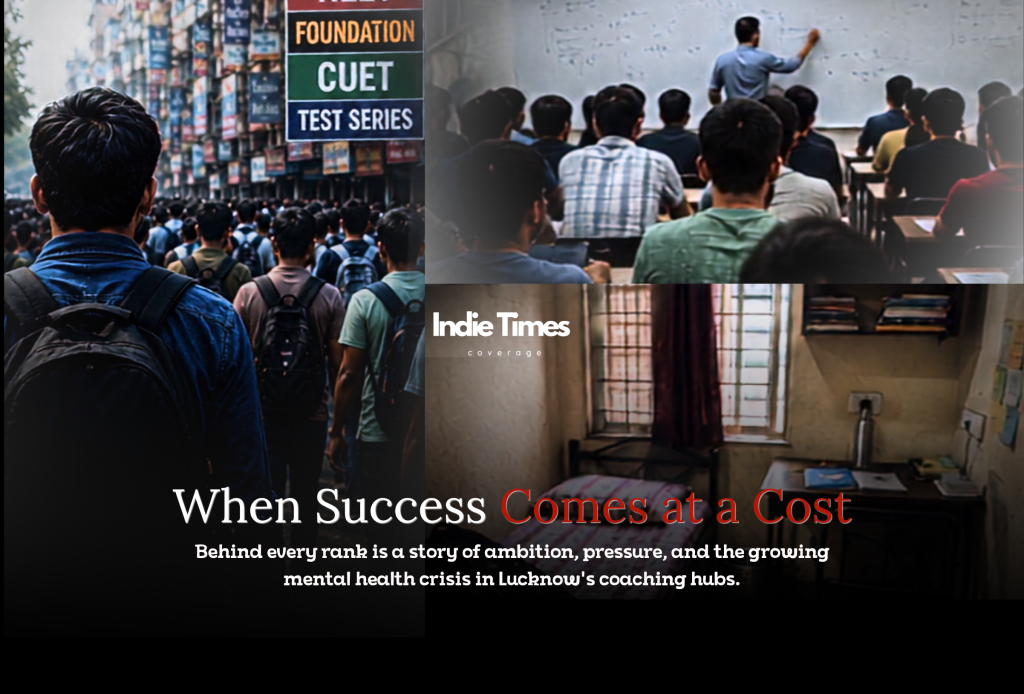
When Success Comes at a Cost

Aliganj’s rise as Lucknow’s coaching capital has intensified academic competition, bringing student stress, anxiety, and mental health into sharper focus.  Every afternoon around 2:00 PM, the streets of Aliganj and Kapoorthala witness a familiar scene. Thousands of students emerge from coaching institutes, carrying heavy backpacks filled with study material as they head back to their PG accommodations. Over the past decade, these neighbourhoods have evolved into Lucknow’s premier coaching hubs, attracting aspirants from across Uttar Pradesh preparing for competitive examinations such as JEE, NEET, CUET, and other entrance tests. The rapid growth of the coaching industry has transformed residential areas into bustling student colonies. To meet the increasing demand for accommodation, many homes have been converted into PGs offering compact rooms with basic amenities. While these spaces provide convenience and affordability, students often find themselves living away from their families in small, shared environments, making it difficult to maintain a healthy work-life balance. For many aspirants, the pressure extends far beyond the classroom. Regular mock tests, demanding study schedules, and the constant race for higher rankings create an atmosphere of intense competition. Coaching institutes commonly divide students into batches based on academic performance, a practice designed to personalise learning but one that some students say also adds to the psychological burden. “Every Sunday brings another test, and every Monday I have to explain my score to my parents,” says a 19-year-old Anuj Sharma, an engineering aspirant from Eastern Uttar Pradesh, “My father has invested everything he had for my education. Sometimes the fear of disappointing my family feels greater than the exam itself.” Mental health professionals believe that prolonged academic stress, homesickness, and social isolation can significantly affect students’ emotional well-being. While a few coaching institutes have introduced counselling initiatives, many students and experts feel that accessible mental health support should become an integral part of the coaching ecosystem. As another batch of students walks through the crowded lanes of Aliganj tomorrow, carrying books heavier than their years, the city may want to pause and ask itself: What defines success, an All India Rank, or a student’s overall well-being? If Lucknow is to remain an educational capital, should its legacy be built solely on examination results, or also on compassion, support, and a healthier learning environment? The answers may determine not just the future of its coaching hubs, but the future of an entire generation.
Read more

 Gupt Navratri: The Journey That Begins Within

Just as Gupt Navratri invites us to look beyond the visible and discover the hidden depths within, Indie Times marks its landmark 25th edition by celebrating the stories that shape the soul of Lucknow. Divya Malik (Divyamaaya) a mental health therapist, spiritual mentor,  researcher and Indie Times Brand Ambassador, whose work explores the meeting point of psychology, consciousness and the timeless wisdom of the Vedic tradition takes us through the spiritual essence of the quaint tradition. In Sanskrit, Gupt means hidden but the hiddenness is not of the Divine; it is of our own inner world. While the more widely celebrated Navratris express devotion through vibrant festivity, Gupt Navratri invites us inward into silence, introspection and the sacred discipline of self discovery.  The Divine Mother has never been distant. It is our awareness that drifts away. These nine nights become an opportunity to return to observe the mind, refine our intentions and awaken the dormant strength that already resides within us. In the quiet of unseen devotion, we often find a depth and clarity that outward celebration alone cannot offer. In many Tantric traditions, Gupt Navratri is also a time of reverence for the Das Mahavidyas; The Ten Great Wisdom Goddesses. They are not merely ten deities to be worshipped but ten profound dimensions of consciousness that illuminate the seeker’s path. Their forms move from gentle to fierce, reminding us that compassion and courage, creation and dissolution, abundance and emptiness are sacred expressions of the same Divine Intelligence.  Each Mahavidya mirrors a truth we must eventually face within. Traditional lineages emphasize that advanced Tantric practices are undertaken only under the guidance of a qualified guru. The true purpose of Gupt Navratri is not to seek miracles but to cultivate transformation. Every mantra becomes an invitation to awareness. Every moment of silence becomes a conversation with the Self.  Every act of devotion becomes a small but steady step toward inner clarity. What we practice unseen often shapes us more deeply than what we perform for the world to witness. Perhaps that is the greatest secret of these sacred nights: the Goddess is not waiting to be found in distant temples, grand rituals or extraordinary experiences. She reveals Herself quietly, in the stillness of an awakened heart, in the discipline we keep when no one is watching. When we honour the Divine within, every night becomes Navratri, every breath becomes a mantra, and every moment becomes a doorway to the infinite. 
Read more

From Cockpits to Courtrooms: The Remarkable Journey of Lucknow’s Well Known Legal Luminary- Charan D.S. Bedi

In the high-stakes avenues of Lucknow’s legal corridors, few names command as much attention and respect as Advocate Charan D.S. Bedi. To mark a major milestone, Indie Talk Show host Charanpreet Singh Bagga sat down with the prominent Real Estate Lawyer for a candid, narrative captured in our 25th special edition of the Indie Times, pulling back the curtain on a man who navigates law with the same velocity he once used to navigate the skies. Bedi’s journey to becoming a cornerstone of Lucknow’s legal landscape managing a powerhouse firm of over 45 lawyers is a masterclass in destiny. “I used to hate the court environment,” Bedi reflected during the broadcast.  Originally trained as a commercial pilot, he swapped the cockpit for courtroom briefs at his mother’s urging during a period of professional uncertainty as he shares, “There were no lawyers in my family. It was entirely destiny.” The conversation quickly shifted from personal history to sharp legal mechanics. As a leading specialist in property law, Bedi shed light on recent structural shifts in Uttar Pradesh, specifically pointing out the state’s aggressive crackdown on the misuse of power of attorney.  Outside of blood relations, third-party property transfers now attract a hefty 7% stamp duty. His core mandate to modern homebuyers remains unyielding: Caveat Emptor buyers beware.  Says Bedi, “People buy properties worth crores but hesitate to hire a legal expert for due diligence,” Bedi warned, emphasizing that proper legal vetting is the only shield against hidden bank mortgages and developer disputes. Yet, what truly defines Bedi is his unapologetic “king-size” lifestyle and unwavering smile, which he describes as his ultimate stress buster. The interview peaked during a witty rapid-fire round where his larger-than-life persona took center stage.  When asked what he would never admit in a court of law, Bedi grinned, “That I am wrong, neither me nor my client.” And if given a single superpower? “To instantly heal my liver, and everyone else’s,” he laughed, referencing his love for celebration and the good life. Equal parts authoritative and fiercely charming, Bedi continues to prove that in the grand court of life, he writes his own judgments. The complete conversation with Advocate Charan D.S. Bedi is available on the Indie Talk Show’s official YouTube channel.
Read more
"Collage of India's development themes featuring a high-speed bullet train, iconic monuments including India Gate and Taj Mahal, a farmer on a tractor, solar panels, a public transit bus, a political leader in saffron attire, and women using digital tablets — representing infrastructure, agriculture, technology, and social progress."

UP Transformation Commission: State’s New Think Tank to Drive Development

A Indie Times celebrates its landmark milestone of 25 editions, Editor, Indie Times draws attention to institutions that will define the state’s future trajectory. The Uttar Pradesh Transformation Commission, as the state’s new apex policy and governance body, represents a significant reform with far-reaching implications that reflects Uttar Pradesh’s evolving development vision and long-term policy direction. The Commission was created by restructuring the erstwhile State Planning Commission, shifting the focus from traditional plan-making to evidence-based policymaking, outcome monitoring execution support. Instead of merely preparing and development plans, the STC will work with government departments to improve implementation, track measurable outcomes and ensure better coordination across sectors. Al the helm of the Commission Chief Minister Yogi Adityanath, who serves its Chairman, while former Uttar Pradesh Chief Secretary Manoj Kumar Singh has been appointed as its first Chief Executive Officer for a three-year term. According to officials, the leadership structure is intended to ensure close coordination between policymaking and execution at the highest level. The Commission’s mandate extends across critical sectors such health, agriculture, infrastructure, urban development, public finance and industrial growth. It is expected to provide policy inputs, create performance-monitoring frameworks, promote inter-departmental convergence and develop district-level scorecards to measure progress. It is also working on initiatives such as a State Data Authority, land asset monetisation, regional economic planning and investment facilitation. The biggest beneficiaries expected to be the people of Uttar Pradesh, as Improved governance and better monitoring are intended to translate into faster delivery of public services, stronger infrastructure, enhanced healthcare, greater employment opportunities and more effective utilisation of public resources. Investors and industries may also benefit from streamlined policy support and coordinated implementation, while govemment departments are likely to receive technical and analytical backing for programme execution with a stated emphasis on data-driven governance and measurable outcomes rather than conventional planning. the State Transformation Commission marks Uttar Pradesh’s attempt to build an institutional mechanism that not only formulates policy but also tracks whether those policies deliver tangible results on the ground. Truly a Landmark Achievement!
Read more
Singer Neeraj Shridhar performing live on stage during a nostalgic Bombay Vikings concert in Lucknow, with vibrant stage lights and fellow musicians in the background.

A Night of Nostalgia: Neeraj Shridhar Rekindles the Bombay Vikings Magic in Lucknow 

Red FM’s live gig at Dayal Gateway Convention Centre turned into a night of nostalgia, sing-alongs, and a  moment fans who attended will forget.. Nostalgia took centre stage as Neeraj Shridhar brought his infectious energy to Lucknow at the Dayal Gateway Convention Centre in a concert organised by Red FM. For an audience raised on his chartbusters, the evening became a joyous trip down memory lane, with every song turning into a massive singalong. The venue buzzed with activity long before the performance, with food stalls and lively hosting setting the mood. Once on stage, Neeraj wasted no time launching into crowd favourites like Tha Tha Kar Ke, Allah Duhai Hai, Chor Bazari, Love Mera Hit Hit and Tum Mile. However, it was classics from his Bombay Vikings days and the iconic Bhool Bhulaiyaa title track that sent the audience into a frenzy, while Character Dheela Hai and Tumhi Ho Bandhu kept the momentum soaring. But it was the old Bombay Vikings-era tracks that turned the night into something closer to a collective memory exercise. The Bhool Bhulaiyaa title track hit like a jolt, and the crowd’s energy spiked instantly   it was, by most accounts, the loudest the venue got all evening.  The evening’s most touching moment came when Neeraj invited fans onto the stage. Among them was Jagjeet Singh, a hearing impaired fan who presented the singer with a hand-painted portrait. Their warm interaction drew loud applause, proving that music’s deepest connections often transcend sound. Despite average audio quality at times, the crowd’s enthusiasm never faltered. As the lights dimmed, Lucknow left with hoarse voices, cherished memories and a renewed love for the songs that defined an era.
Read more
Heat map of Lucknow displayed alongside a modern residential building, illustrating the urban heat island effect and rising temperatures across different neighbourhoods due to rapid urban development.

The Heat Map of Lucknow: Why Some Neighbourhoods Are Feeling the Burn this year

As summers grow longer and more intense, Lucknow’s rising temperatures are exposing a stark reality: not every neighbourhood heats up the same way. Localities dominated by concrete, glass façades and sparse tree cover are turning into urban heat islands, often recording noticeably higher temperatures than greener pockets of the city. In Lucknow areas with dense commercial activity and rapid construction tend to retain heat well into the night, making evenings increasingly uncomfortable for residents. In contrast, neighbourhoods with mature trees, parks and open spaces experience relatively cooler conditions, underscoring the role of urban greenery in regulating temperatures. Think Lucknow Cantt and Gomtinagar Extension where dense green cover still is preserved and the drop in temperature is quite evident as you drive through. Environmental experts say the city’s shrinking green cover, expanding road network and increasing vehicular emissions are amplifying the heat stress, explains a climate change activist, “Trees provide shade, reduce surface temperatures and improve air quality, while parks and water bodies help moderate the local climate. As development accelerates, striking a balance between infrastructure and ecology has become a pressing challenge with the latter always losing out.” The shift now is quite inevitable. The residents are adapting in their own ways. Morning walks are shifting to earlier hours, rooftop gardens are gaining popularity, and many housing societies are planting native trees to create cooler micro-climates. Households are also investing in reflective roof coatings, shaded balconies and energy-efficient cooling systems to reduce indoor heat. Though urban planners believe the solution lies not only in individual efforts but in city-wide planning. Expanding green corridors, protecting existing parks, promoting rainwater harvesting and encouraging cool-roof initiatives can help reduce the urban heat island effect. Experts also advocate integrating climate resilience into future building and road projects rather than treating it as an afterthought. With climate change making extreme heat more frequent, Lucknow’s battle against rising temperatures is no longer just about surviving summer. It is about reimagining the city’s growth so that development and environmental sustainability go hand in hand, ensuring that every neighbourhood remains liveable in the years ahead. Will be able to do that and salvage the damage done to mother earth on time so that we can leave the next generation a clean and green planet? Only Time Will Tell.
Read more

Recent News

Registered Office

2nd floor, Rohit House, Shah Najaf Road,
Lucknow-226001

Email Us: enquiries@indietimescoverage.news

Contact: +91 522 4343939  |   +91 94735 01234

RNI No: UPENG/25/A3578

Copyright @ 2026 indie times coverage. All Rights Reserved.

Powered by Bito Technologies