
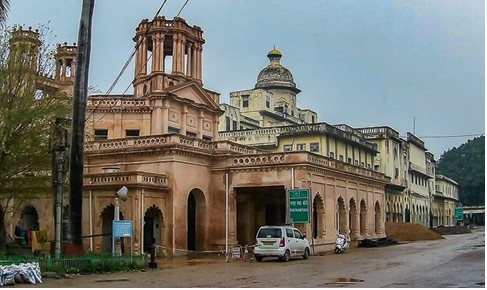
A tale of love, power, betrayal, and legacy from the era of Nawab Wajid Ali Shah still lingers in Lucknow’s memory, reflected in the city’s timeless architecture. These enduring structures stand as silent spectators to a bygone era, keeping alive the rich heritage that continues to define the city’s skyline
In the rich and layered history of Wajid Ali Shah, the last Nawab of Awadh, few stories are as dramatic and lesser known as that of his beloved consort, Mashooq Begum, later honored with the title Qaisar Mahal.
Mashooq Begum held a special place in the Nawab’s life. Upon the birth of a son, Wajid Ali Shah bestowed upon her the prestigious title of Qaisar Mahal. In her honor, he is said to have developed the grand complex of Qaiserbagh Palace Complex, one of Lucknow’s most iconic architectural landmarks.
At the heart of Qaiserbagh stood a magnificent white pavilion known as Qasr ul Aza, surrounded by four imposing gateways. Today, only two of these gates remain, as the other two were destroyed by British forces during the upheaval of the Indian Rebellion of 1857.
The Nawab’s affection for Qaisar Mahal extended beyond Qaiserbagh. A historic building originally constructed during the reign of Naseer-ud-Din Haider for his minister Roshan ud Daula, known as Roshan ud Daula Kothi, was later renamed Qaisar Pasand by Wajid Ali Shah, further reflecting his devotion.
However, this royal relationship took a dramatic turn. When Wajid Ali Shah was exiled to Kolkata, he took Qaisar Mahal and their son along with him. During this period, the Nawab received a monthly allowance of one lakh rupees from the British government. It is said that Qaisar Mahal conspired with colonial authorities to secure a personal share of five thousand rupees from this stipend.
When the Nawab learned of this betrayal, he was deeply hurt. In response, he divorced Qaisar Mahal and ordered the demolition of her palace. In a symbolic act of erasure, even musical instruments like the tabla and harmonium were reportedly buried within the ruins. The Nawab later justified this act by stating that he had elevated her status, but she misused the honor given to her.
Historian Zulkifl Rizvi, feels this anecdote remains one of the most intriguing yet lesser discussed narratives of Awadh’s royal history. He notes that the naming of Qaiserbagh after Qaisar Mahal reflects the Nawab’s deep personal attachment, blending romance with architectural legacy.
Highlighting the symbolic significance behind the destruction of her palace and the burial of musical instruments, Rizvi shares, “For a ruler like Wajid Ali Shah, who was deeply connected to art and culture, this act was not just punitive but also a statement meant to resonate with the people of Awadh, the monuments still standing today are a grim reminder of that even now betrayal in love can etch the deepest wound.”
The story of Qaisar Mahal continues to survive from generation to generation across Lucknow, even as physical traces of her presence have faded over time. Despite this tragic end, Qaisar Mahal’s legacy remains etched in Lucknow’s heritage. The elegant Moti Masjid, located near Sheesh Mahal, is believed to have been commissioned by her, standing today as a quiet reminder of her once prominent place in Awadh’s royal court.
Walking past its remnants, localities but imagine the lives it once held within its walls, the conversations, the elegance, the echoes of a bygone era. Today, it stands more as a memory than a monument, yet it refuses to be completely lost to time.
The rise and fall of Qaisar Mahal isn’t just history, it feels personal, like a reminder of how quickly beauty and power can fade, but never truly disappear from a city like Lucknow.