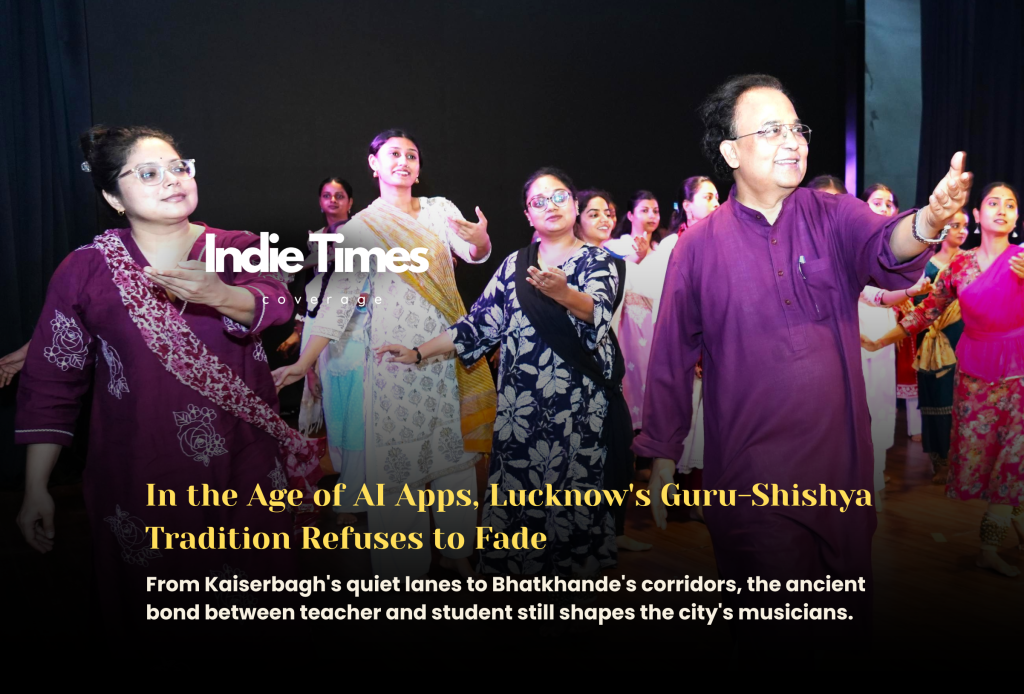
In an era of two-minute reels, instant certification, and AI apps, one might assume the traditional Guru-Shishya Parampara is facing an existential crisis. Yet, walk down the lanes of Kaiserbagh on a quiet evening, past the historic corridors of Bhatkhande Sanskriti Vishwavidyalaya, or saunter around the UP Sangeet Natak Akademi bylanes and you will hear a different story. On Teachers Day, Indie Times salutes the spirit of Guru Shisya Parampara in the city as we trace the legacy of this quaint tradition.
New-age music courses may be remarkably good at giving students information but does it endure? Today with a few clicks, a student can understand scales, finger positions, rhythm patterns and even practise basic bandishes within the comfort of their home, and no doubt for someone just discovering music or the finer arts these courses can be a wonderful first step.
But ask a serious learner in Lucknow, and the conversation often goes deeper. Explains Aditya Singh, a self taught student of music, “Music is not only about getting the notes right. A computer may tell you where your fingers should go, but it cannot always notice the tiny tension in your wrist during a fast tabla passage, the hesitation before a taan, or the difference between simply singing a meend and actually feeling it. These are things a teacher notices because they have spent years listening, practising and making the same mistakes themselves. I learnt a lot of things online but understood the deeper nuances only when I trained under a guru.”
Not surprising though as Lucknow has always understood this relationship between teacher and student for generations. The city’s musical identity has been shaped by a tradition in which knowledge is not merely written down, it is heard, observed and lived.
The legacy of the city’s music learners also finds a mix of traditional and contemporary training spaces. Institutions such as the U.P. Sangeet Natak Akademi and local academies offering vocal, tabla, keyboard, guitar and other disciplines reflect how Lucknow’s musical ecosystem continues to evolve. The city can now offer both the convenience of structured courses and the intimacy of personal instruction.
While technology has not necessarily taken the Guru’s place, in many cases, it has simply extended the Guru’s reach. A teacher in Lucknow can now guide a student thousands of kilometres away through a live one-to-one session.
For the modern learner, an online course may open the door. But when curiosity turns into commitment, something changes. The student begins searching for correction, interpretation, improvisation and a deeper musical voice, this is where the importance of a guru comes out strong, who the student can revere and look upto to hone his own skills to perfection.
That is where the old relationship between Guru and Shishya still matters.
In Lucknow, the journey may begin with a screen, but for many serious musicians and their students, it eventually comes back to a teacher sitting across from them, listening, and saying, “Phirse Karo,.” (repeat again)!
“An App Doesn’t Know When You Are Hurting”
“An app can teach you the steps, but only a Guru can teach you Kathak. Books give you information, but an Ustad gives you Taleem—transmitting the soul, the rhythm, and the living grace that no screen can ever capture.”says Nischal Shukla, a Kathak dancer from Bhatkhande University.