There was a time when mushairas were seen as the preserve of serious literary circles — elderly patrons in crisp achkans, scholars debating metaphors long after the event ended. But something has shifted. Today, the front rows are filled with college students. Young women record verses softly on their phones. Boys who grew up on reels and rap, whisper “wah wah” with surprising sincerity.
Winter evenings in Lucknow have a rosy hue to them, but now there’s a certain warmth in the air that has nothing to do with the weather. In a café tucked inside Hazratganj, in a college auditorium, in an old courtyard in Chowk, even on someone’s terrace under a shawl of fairy lights, poetry is being recited again. And every time a poet pauses after a stirring line, the crowd responds almost instinctively: “Irshaad! Irshaad!”
What wonder then that Gen Z today has discovered poetry that hits differently when it’s spoken aloud. In a world of 15-second clips and endless scrolling, there’s something about sitting still and listening, really listening, to a poet take their time with a thought.
A heartbreak sounds heavier when it echoes through a hall. A line about longing feels sharper when the audience falls silent before erupting into applause, nuances that remind you of yesteryears and the bygone era when the literati of Lucknow were frequent visitors to such gatherings.
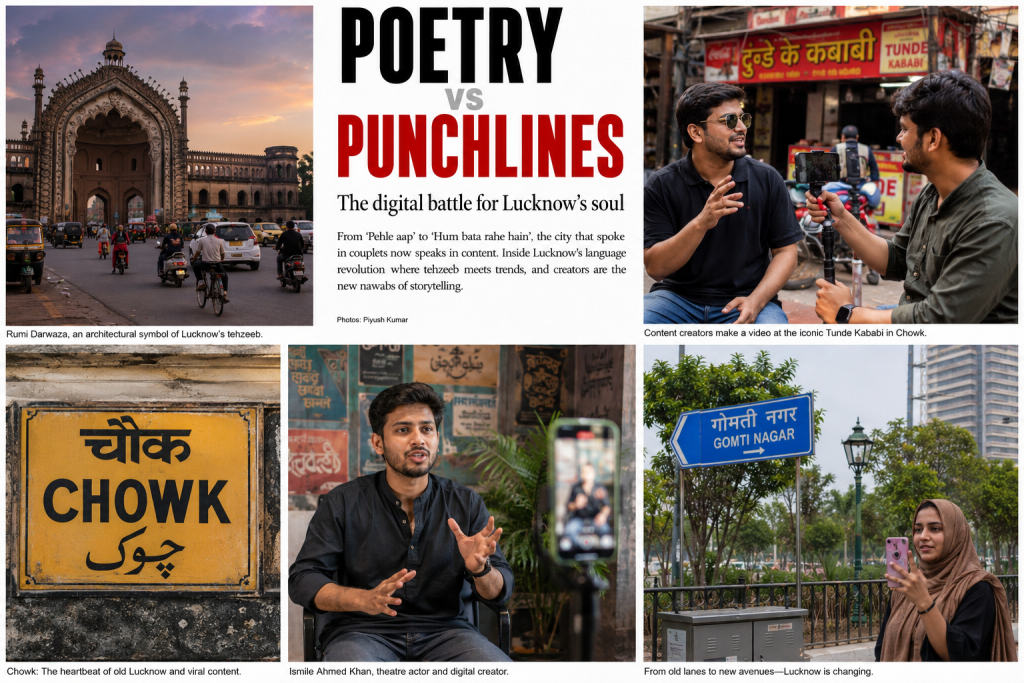
Social media, ironically, has helped bring this old-world format back into focus. Snippets of Urdu and Hindustani couplets go viral. A well-recited sher circulates on Instagram. Suddenly, words once confined to dusty books are being captioned under selfies and shared in stories. But the screen is only the beginning.
Khushbir Singh Shaad, noted poet and writer, says that for a city long proud of its tehzeeb, the revival of the mushaira is not a passing trend but a true homecoming.
He credits social media for taking shayari to the masses. “Today, verses are easily accessible online, simple to understand, pleasing to hear, and highly relatable for younger audiences. With many in Gen-Z unfamiliar with the Urdu script, publishers are increasingly printing Urdu poetry in Hindi, making it more accessible and instantly popular.”
Shaad observes that much of the shayari trending online explores heartbreak, pain, escapism, and unfulfilled love themes that resonate deeply with young people. As many are still finding their footing in life and often feel uncertain about the future, they naturally gravitate toward poetry that echoes their emotions and lived experiences.
But what truly draws them in is the live experience is the depth of the poet’s voice in a live poetry session, the deliberate pause before the final word, the collective gasp at a clever twist. It’s not just about literature; it’s about being present in a room where everyone feels the same line at the same time.
In Lucknow, where culture is never really lost but simply waiting to be rediscovered, the mushaira’s revival feels natural. The younger generation isn’t just attending, they’re participating, writing, performing and reclaiming. So as long as there’s someone in the crowd ready to say “Irshaad,” poetry here will never go out of style.